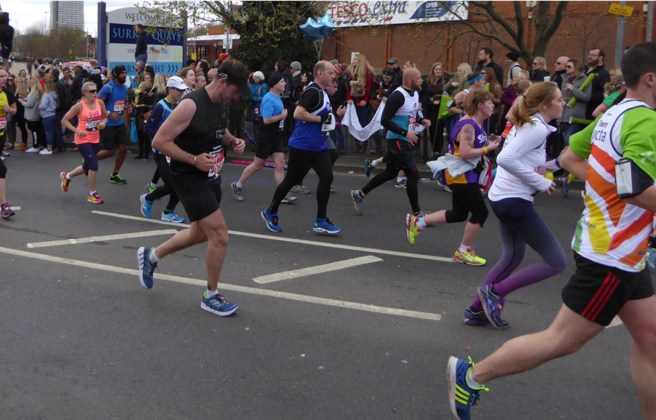
Paul at 14km in the 2016 London Marathon. Going well. Nice and relaxed.
Run Fat Boy Run – From the heart

Paul at 14km in the 2016 London Marathon. Going well. Nice and relaxed.
The build up to an ‘A’ race is always nerve wracking. We all react differently to this stress. Your body can’t distinguish between different types of stress. As far as it’s concerned this is flight or fight! So do calm things before big races. Feet up. Light reading. Easy wandering about. Enjoy the race centre and the fantastic race ambiance. CALM!
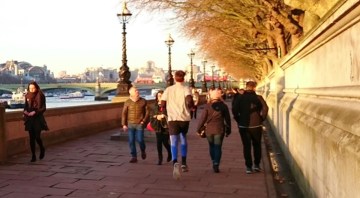 Paul is super strong and rarely gets injured so it was a bit of a shock to get a phone call from Hong Kong airport to report a knee pain. By the time he landed at Heathrow we’d managed to get a physio appointment with Prosport physiotherapy in Huddersfield to get it checked out. I find many people including myself get niggles just before races. It’s important to put a rational head on in these circumstances. Will you do real damage if you compete? If so DON’T RACE. Luckily Paul has been given the okay.
Paul’s race tactics are to get behind a pacer and stick to them like glue. These guys are paid to accurately pace the race. Most people start too quickly. Only a small amount over pace can put you in difficulties in the later stages because you’ve burned up your stored glycogen. This means it’s not available when you really need it. In a marathon don’t make any effort till 20 miles. Easy, super relaxed running. Tuck in behind other runners to get a drafting advantage. Anything to save energy. The final 6 miles is the glory leg. You’re now warmed up for a 10km race. Enjoy passing those runners who went off to fast.
I’ll be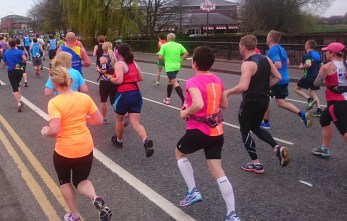 watching out for Paul on the course on Sunday. The chances of seeing him are just above nil. It will be a great day. Run fat boy run!
On a personal note. London marathon day is always poignant. Aged 18 I helped at the finish of the World Orienteering Championships in Scotland. My father was in charge of the finish and the timing. One evening we were in the pub with Chris Brasher and John Disley the founders of the London marathon. They an ambitious idea to organize a marathon in London with maybe 5,000 runners. The finish and timing needed a safe pair of hands so they approached my Dad to do the job. Unfortunately, his employer wouldn’t give him time off so, no free London marathon entries for me! This race is testimony to people with vision.
Another week in paradise. Ok. China. Paul has been posting some nice runs in Chinese parks this week. All very easy. Perfect taper runs.
 Exotic training opportunities
This gives an opportunity to comment on how training need not stop if you are a frequent traveler. In fact it’s a great way to explore new towns and countries. If I’m travelling in the UK I always pack my trainers, bike if possible, rollers, and swim kit. You never know what opportunities might turn up. Maybe a swim in the sea. Canal towpaths are great places to run. You can ride in new places and different terrain. How I love to visit flat lands. Makes a pleasant change from the steep Pennine hills at home. The rollers are great for indoor training in hotel rooms if you can sneak your bike past the receptionist! Paul has clocked up runs in Australia, USA and now China already this year.
Tapering is all about giving your body a chance to recover. This works best if you continue to train but at vastly reduced volume. Short easy runs are the order of the day. A word of warning you will probably feel tired and wonder if it’s doing you any good. Persist and you will start to feel tip top ready for your big race. Paul’s tapering has been excellent. Unfortunately the long flights won’t be beneficial.
I’m off to see Paul at the London marathon this weekend. Taking my kit so I can get in a few miles running to and from the race route. Also might try to get in a Park Run on Saturday in Burgess park (pan flat). If you keep an open mind there are always opportunities to train.
The Dark Art of Tapering

For the uninitiated the period just before a race is known as tapering. This is where you let your body recover from all the hard training you have done over the last few months. In doing so you become stronger and ready for your big race.
We use Training Peaks to measure Paul’s athletic performance. If we can achieve his Chronic Training Load (CTL) and Training Stress Balance (TSL) to coincide on the day of the London Marathon then Paul will run like a dream. (Ideally the TSL score will be about +1) Getting this to happen is really difficult. With Olympians it’s easy. They can rest whenever they want. Unfortunately, the rest of us have to work, look after families and fit training into our busy schedules. In Paul’s case he is flying to China and back. Not exactly the best taper.
A traditional taper should involve similar training sessions to your norm but at much reduced distance and intensity. You DON’T STOP TRAINING. What usually happens is you feel absolutely exhausted as your body goes into repair mode. Hopefully by week 2 or even week 3 if you are on a long taper you are feeling refreshed. In these weeks the training load is even lower.
 The new ‘Chinese’ taper for Paul is going to be a reverse taper. This is very little training but plenty of walking this week as he enjoys China. He will hopefully feel dreadful as his body repairs. Next week we will up the training again but only to a very low level. Hopefully CTL and TSB stars will align and he will hit the start line in London at peak condition.
This week’s training focus
Easy training. Testing new trainers. Plenty of walking.

Have you noticed how everyone is different? I used to work with dancers. They would see a series of complex dance moves and then just do the dance. A fabulous skill learned over many years. Non dancers would struggle for hours before getting to grips with a routine. The flip side was trying to get a dancer to learn some dialogue. Often this was outside their comfort zone and they found it difficult. It’s the same with triathletes. Everyone has their strengths but some things don’t come naturally and we have to work hard to achieve the performance we want.
As a coach I find this endlessly fascinating. Often what you’ve done as a kid really helps. Junior swimmers can return to the pool later in life and soon regain their fitness. Their swim technique never leaves. At the track we can spot someone who has been a runner in their youth within them completing a few paces. Good technique and timing persist.
Note to parents. Get your children competing in anything and everything. It’s such an important part of their development. Join Wakefield Junior Triathlon Club for example
Paul missed out on the competition element of his sporting childhood. He never got to ‘red line’ in cross country running, swimming galas and the like. He did however learn endless fortitude. Start him in a long race and he will stick at it with no thought of giving up. Something very few people learned in their childhood and will regret when they tackle Ironman.

Ok, the Paul’s Dewsbury Park run was slow. A wonderful example of Level 2 running. Great training but not racing. To achieve a good
time in London is still on the ca
rds. Paul is fit. We simply need to find a way to engage his fortitude but at a faster pace. Luckily the good organisers of the London Marathon are going to provide us with the trick to do just that. More later.
One week of hard training left. Tapering then starts next week. We will be trying reverse tapering. Not out of choice but due to Paul’s work commitments. See next week’s blog
Most of Paul’s training is completed at level 2 intensity (we use a 5 level scale derived from Bourg scales). We’ve based his training paces on VDOT predictions and Paul has mainly hit the targets. If we were using a MAF training pace with heart rate at 180 – age -5 which is a heart rate of 135 for Paul then this would also show he has been training at perfect pace for building long distance aerobic endurance.
We use the principle of polariz ed training. This is where most of Paul’s training load is at level 2. Many people train too hard. The belief that there is no gain without pain is a nonsense. For years we’ve been conditioned by the fitness industry to train hard all the time. The difference in training effect between Level 4/3 training and Level 2 is minuscule. Except you don’t get injured, recover quicker and can ultimately do more training if you train at lower levels of intensity. To my mind this is a no-brainer.
HOWEVER. There is always a counter side. As we approach races we have to do some tempo training at level 3 or above. In fact, I like my athletes to do one or two hard sessions per week. This is mainly to condition the mind for racing. Paul can run faster but he has to believe he can push himself harder and still succeed. The Lincoln Park Run breakthrough time was evidence of this. You have to race to become good at racing.

It’s the last couple of hard weeks before London. Paul is doing at least 5 runs. I would like him to warm up on his lovely WATT bike before each run if possible. This is because I’ve got in mind the switch to Ironman training as soon as London is achieved. Hard efforts in each run (foot niggle permitting) will be good. Maybe a final Park Run this weekend.
Great to hear Paul’s Mum is out of hospital. I’ve gone through a period where my Mum was in hospital for a long period and understand how difficult this is for everyone. Hopefully she can continue to make progress back at home.
Last week Paul posted in a great week of training. The highlight was of course, knocking 1:30 off his PB at the Lincoln Park Run. What pleased me most was the psychological breakthrough this represented. The analogy I gave Paul when we last spoke was Roger Bannister breaking the 4 minute mile for the first time in 1954. Many had tried before Bannister’s attempt but there was a common belief the 4 minute mile couldn’t be done. Once this barrier was broken only 46 days later New Zealander John Landy broke Banisters record and others quickly followed suit. It is remarkable what we can achieve in running if we believe it’s possible.
‘Knowing’ how to run quicker means you can repeat the feat. If you plateau in your running and feel you’re no longer improving, try Paul’s trick. Choose a low key race, go super hard at the beginning and hanging on till the end. 5km Park Runs are perfect for breakthrough runs.
The goal this week is to complete at least 5 training runs. It would be good to use the WATT bike to warm up for 15 minutes before some of the runs. This way Paul can get in some extra training time and some make the sessions more triathlon specific. Trying to fit this into a busy schedule will be the challenge. I’ve asked Paul to run at his anticipated marathon pace for substantial parts of his longer runs to get used to running at this speed.
To finish this blog I’d like to pay tribute to John Disley a contemporary of Roger Banister. Disley co-founded the London Marathon with Chris Brasher in 1981. (Brasher had been one of the pacers for Bannister in the 4 minute mile attempt). Without these remarkable, farsighted athletes, breaking down barriers to get the London Marathon on the calendar, Paul wouldn’t have a date with destiny in a few weeks’ time.
 Paul Kemshell